


Bac Bien Village Balances Urban Development with Heritage Preservation
Located on the
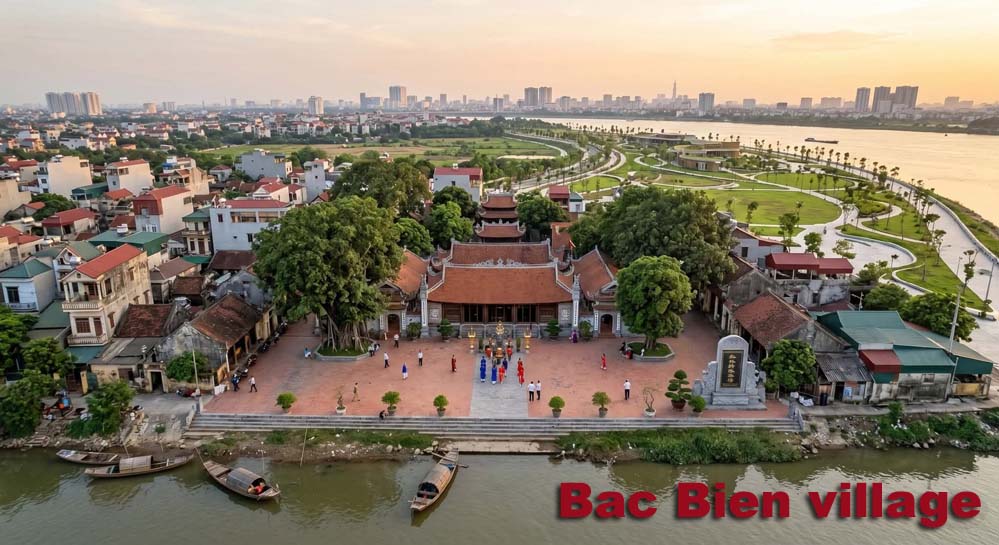
left bank of the Red River, the ancient village of Bac Bien (Bo De ward)
preserves a part of the historical image of Thang Long - Hanoi. Amidst the
pressures of urbanization and future planning, the challenge of preserving
the ancestral spirit while developing sustainable livelihoods for the local
people is finding a solution right from the explorations of international
tourists. Awakening the potential of community tourism and transforming
heritage values into drivers of development is a sensible approach, guiding
this thousand-year-old village steadily forward. - Tailor-made Vietnam tours
The "soul" of Thang Long in the riverside village
If you take Hanoi's Old Quarter as your center, simply crossing the Chuong
Duong or Long Bien bridges to the left bank will immediately reveal a space
completely separate from the hustle and bustle of the city. This is the
ancient village of Phuc Xa - Bac Bien, a strip of alluvial land shaped like
a peaceful "green oasis" embracing the swirling red waters of the Red River.
For tourists , especially high-end international groups - those staying in
5-star hotels in Hanoi and always seeking authentic cultural experiences -
Bac Bien Village is a surprising and captivating discovery right in the
heart of the capital city.
In early June 2026, we had the opportunity to visit Bac Bien village,
following a group of five family members from Iceland to fully experience
the unique charm of this riverside land. The journey began early in the
morning with a cycling tour around the village. Under the guidance of our
tour guide, Dan Tran, the group leisurely cycled through the moss-covered
Phuc Xa village gate, where ancient Chinese characters praise the land's
auspiciousness and talented people.
Amidst the refreshing morning air, visitors from afar marveled at the
fascinating contrast: on one side, the Red River flowed endlessly, its
waters swirling with red silt; on the other, the ancient village with its
exposed brick houses covered in lush green vines.
The most profound highlight was the visit to a typical family with four
generations living together in the village. Stepping across the rustic stone
steps, the group was greeted by the host with warm smiles and handshakes. In
the solemn main hall, where the ancestral altar is solemnly adorned with
fragrant incense, visitors were introduced to the tradition of ancestor
worship - a moral bond and a core spiritual aspect of Vietnamese culture.
The father in the Icelandic tour group emotionally shared that, in his
industrialized country, generations often live separately; witnessing a
large, multi-generational family living together and preserving their family
traditions, as in Bac Bien, was an incredibly meaningful and inspiring
experience.
After the tour, the whole group gathered around a wooden table to enjoy warm
green tea and plates of ripe, early-season lychees. The conversations
flowed, from the history of An Xa village's founding during the reign of
King Ly Thai To, the story of the resilient people clinging to the river and
land through floods, to the similarities and differences in climate and
lifestyle between the two countries.
Visitors can visit a typical family with four generations living together in
the village, chat with them, and learn about the local culture.
Dan Tran shared: "Western tourists, especially family groups, absolutely
dislike commercially-oriented, pre-arranged tourist attractions. What they
seek is authentic interaction with the local people. They want to cycle
through winding alleys, smell the smoke from cooking fires, see elderly
people chewing betel nut on their porches, and hear stories about their
family history. Bac Bien Village has plenty of those vibrant elements. The
strong family structure and the natural hospitality of the people are the
most luxurious tourism resources that no modern theme park can replicate."
The satisfaction of visitors is not simply a random, spontaneous phenomenon.
From a management perspective, it is the inevitable result when the original
values of the ancient village align with the strategic direction and policy
framework that the Hanoi government has been striving to build over the past
period.
An Icelandic tourist family poses for a commemorative photo with a
four-generation extended family of local residents in front of their home.
To transform this thousand-year-old heritage into a driving force for
sustainable economic development, it is first necessary to decipher the
unique cultural, historical, and geographical resources that Bac Bien
possesses. This is not just an ordinary agricultural area, but a core
heritage region with a structure closely connected to the history of Thang
Long - Hanoi.
At the core of this resource system is a cluster of national-level
historical and cultural relics including Phuc Xa communal house and Phuc Xa
pagoda. The ancient Phuc Xa communal house is dedicated to the village's
tutelary deities and the Grand Marshal Ly Thuong Kiet, the outstanding
national hero who wrote the famous poem "Nam Quoc Son Ha" (Mountains and
Rivers of the Southern Country).
Meanwhile, the tranquil Phuc Xa Pagoda houses the ancient An Xa Bronze Bell
- a National Treasure recognized in early 2026, with the heritage of nine
engraved feudal royal decrees. The vitality of Bac Bien also lies in its
traditional festival held from the 6th to the 10th of March in the lunar
calendar , featuring a unique water procession ritual on the Mother River,
along with the Vietnamese Mother Goddess worship tradition, which has been
recognized by UNESCO.
Assessing the inherent potential of the ancient village, Mr. Nguyen Ngoc Anh
- Director of Phuong Nam Trading and Service Joint Stock Company - analyzed:
"The greatest strength of Bac Bien village is its unique geographical
location and the original nature of its ancient village landscape. Located
less than 10 minutes from Hoan Kiem Lake, yet upon entering the village
gate, visitors feel as if they have stepped into another world . The
village's potential lies in exploiting its inherent values. The presence of
the National Monument cluster, the story of the hero Ly Thuong Kiet, and the
National Treasure An Xa ancient bell are the 'core brands' that will make
Bac Bien a model destination for sustainable community tourism, creating
fair competition with Duong Lam or Bat Trang".
Sharing the same viewpoint, from the perspective of a local resident
directly involved in the profession, Mr. Mac Hung Cuong - a resident of Bac
Bien village, currently working at a tourism company and in charge of a
volunteer project on community tourism development in the area - shared:
"Through my work and practical experience in many countries such as
Singapore, China, Japan, South Korea, France, Italy, etc., I have noticed
that these countries have very effectively exploited villages with long
histories, where communities have lived for generations. Models such as
'community tourism villages' and 'villages within cities' are very
attractive to international tourists because they are places where local
culture is preserved and presented in an authentic and vivid way."
Bac Bien village has all the favorable conditions for development in this
direction. Besides the system of national-level historical temples and
pagodas, and the An Xa ancient bell, a national treasure, the village also
preserves the temple system dedicated to General Dao Ky, the Tam Phu Mother
Goddess worship, and the presence of many long-standing families such as the
Ngo, Nguyen Phu, and Le Dang families... Most notably, it proudly boasts being
the birthplace of the outstanding national hero Ly Thuong Kiet.
Besides its rich cultural heritage, Bac Bien boasts a prime location along
the Red River tourism axis, just over 2km from Hanoi's Old Quarter and about
1km from the historic Long Bien Bridge. This provides an ideal foundation
for developing diverse tourism types, from community-based,
cultural-historical, and spiritual tourism to traditional educational
tourism , MICE tourism, and experiential accommodation right in the heart of
the city. In the future, we hope to seek input and collaborate with local
authorities, specialized agencies, and the community to research, propose,
and jointly develop tourism in Bac Bien village, contributing to the
preservation and promotion of the heritage values of Bo De ward in
particular and Hanoi city in general.
The combination of glorious historical elements, ancient spiritual
architecture, and the natural landscape of the riverside alluvial plain
gives Bac Bien a solid foundation to confidently enter the heritage economy
arena.
Awaken your inner self and your desire for a stable home
The aspiration to build a heritage economy based on the principle of putting
people at the center in Bac Bien is entirely achievable through a
multi-tiered product axis, closely connecting intangible cultural heritage
and natural ecology.
According to Mr. Nguyen Ngoc Anh, the first core product line is Culture -
Spirituality combined with Traditional Education. This content axis
transforms the cluster of ancient relics into a visual history learning
space for the younger generation, while also opening the door to the
captivating intangible heritage with the spirit medium rituals at the
temples and shrines in the village. For international tourists, this is a
powerful "magnet" thanks to the magnificent and authentic combination of
mystical folk music, graceful sacred dances, and colorful costumes.
Continuing the spiritual aspect, the second product line focuses on
livelihoods and direct income streams for households through experiential
tourism. This service axis is designed as a closed loop: developing garden
homestays to allow tourists to live at a slower pace outside the dike;
implementing a "home meal" model where tourists can go to the market with
the host, cook, and enjoy the abundant agricultural products of the alluvial
plain; and finally, exploiting team-building programs and cycling to take
advantage of the vast green space outside the Red River dike. This value
chain is further expanded through spaces for interaction with nature and
landscapes, village festivals associated with water-carrying rituals, and
modern check-in points for young people such as art cafes and natural film
studios harmoniously integrated with local architecture.
For this multi-tiered service chain to operate effectively, the roadmap for
bringing ideas to life requires scientific preparation through specific
steps. It begins with proactively seeking guidance and approval from local
authorities to establish a solid legal framework for the pilot model. Next,
the locality collaborates with travel experts and specialized units to
develop a detailed operational plan and standardize service procedures
before submitting the framework proposal to the competent authorities for
approval.
The crucial step that will determine success or failure is the training of
internal resources, providing skills in hospitality, service etiquette, and
basic foreign language communication to the farmers and elders themselves,
in order to preserve the authentic and hospitable local character. Finally,
the ancient village will officially launch its practical implementation
based on product groups that have strong inherent advantages.
"Within the broader development of the capital city, the community-based
tourism model in Bac Bien is a quintessential piece, proving that a
thousand-year-old heritage and a modern city can find common ground, a
perfect blend to help the nation rise together," Mr. Anh emphasized.
Looking at the overall picture, the development of community-based tourism
in Bac Bien ancient village is perfectly in harmony with the strategic
vision of the Red River Landscape Boulevard Construction Project, aiming to
transform the "Mother River" into a green space center of the capital in the
new century. Developing community-based tourism is the golden key to
resolving the dialectical relationship between conservation and development,
between the interests of the State and the long-term livelihoods of the
people, enabling the thousand-year-old heritage to break through and shine
proudly in the new era.
Source:
Breathing New Life into Bac Bien Through Culture Tourism